
Table of Contents
- What an Active Retirement Lifestyle Looks Like
- How to Choose a 55+ Community That Matches Your Goals
- Amenities in 55+ Communities Worth Prioritizing
- Cost of Living in an Active Adult Community
- Retirement Homes in Southbury: What to Expect
- Building an Active Retirement Lifestyle Outside a Residential Community
- Transportation, Accessibility, and Healthcare Planning
- Red Flags When Evaluating a Retirement Community
- Frequently Asked Questions
Last Updated: October 21, 2026
What an Active Retirement Lifestyle Looks Like
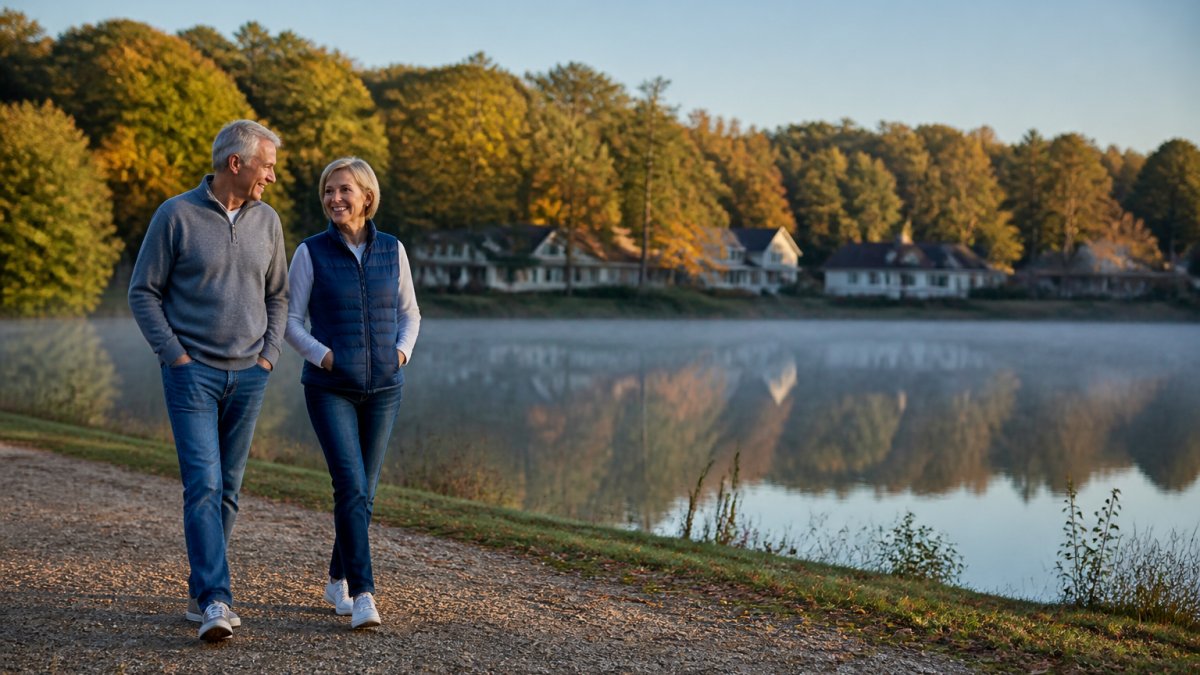
For many retirees, this looks like golf, tennis, fitness classes, or hiking; others prioritize volunteering, lifelong learning, or travel. The key is intentional choice.

Retirement is a status change; an active lifestyle is a daily practice that builds structure, community, and purpose. Research shows retirees who maintain social connections and physical activity report higher life satisfaction and better long-term health outcomes (pubmed.ncbi.nlm.nih.gov).
At CT Heritage Village, residents enjoy organized activities alongside the freedom to pursue their own interests.
How to Choose a 55+ Community That Matches Your Goals
Choosing the right 55+ community requires clarity about what you want.
Tour multiple communities and watch the residents: are they genuinely engaged, or do common areas feel empty?
Ask specific questions about amenities, services, and costs: How many social activities happen weekly?
Visit at different times of day, a community vibrant on Saturday may feel quiet on Tuesday morning.
Amenities in 55+ Communities Worth Prioritizing
The best amenities match your actual lifestyle, not the developer’s wishlist. Before getting excited about a golf course, ask: Do I actually play golf? Would I use a pottery studio?
Fitness and Recreation Facilities
Fitness facilities are worth prioritizing if you care about staying active and strong.
Pools serve lap swimming, water aerobics, and socializing; tennis and pickleball courts attract competitive and casual players; walking trails encourage daily movement without formal exercise.
A well-used fitness center comes down to programming and culture: scheduled classes, personal training, and a social vibe get used; one that’s just “available” sits quiet.
Social Activities and Community Engagement
Social activities are the heartbeat of an active retirement community.
Pay attention to how activities are organized. Resident-led clubs create deeper engagement and ownership than staff-run events created just to fill a calendar.
Check whether the community supports outside interests: local gardening clubs, college partnerships, volunteer connections. The best communities don’t trap you inside, they help you engage with the wider region.
Cost of Living in an Active Adult Community
Most listings give a monthly fee and stop there, a number that’s rarely what you actually pay or comparable across communities. Build a total-cost picture you can compare with staying in your current home.
Build a four-bucket cost model
Before you tour, set up a spreadsheet with four buckets. Every community gets the same four columns, so you compare like with like.
- Acquisition and entry. Deposit, entrance fee, buy-in, or membership fee, plus closing costs and any refundability terms. Ask whether the entrance fee is refundable, partially refundable, or non-refundable, and under what conditions.
- Recurring monthly. Base fee plus any mandatory add-ons such as a dining minimum, parking, pet fee, second-occupant fee, or cable and internet bundle.
- Usage and a la carte. Guest meals, extra housekeeping, personal training, salon services, storage, garage, and activity fees that are not in the base.
- Contingent and future. Annual increase history, special assessments, and the cost of moving to a higher care level on site if the community offers one.
Connecticut cost drivers to ask about specifically
Costs in this state are shaped by factors that do not show up on a brochure:
- Property tax treatment. Ask how the community’s real estate taxes are handled and whether any portion is passed through to residents. Tax treatment can differ between a condominium-style ownership unit and a rental or membership model.
- Heating and utilities. Older housing stock and cold winters make energy costs material. Confirm whether heat, hot water, and electricity are included or billed separately, and ask for a typical winter bill from a resident.
- Snow and grounds. In a standalone home you pay for plowing, salting, and landscaping. In a community these are usually bundled, which is part of what the fee buys. Get the scope in writing.
- Insurance. Confirm what the community’s master policy covers and what you must insure yourself, such as contents and personal liability.
Compare against staying put, line by line
Don’t compare a monthly fee to a mortgage payment. Compare it to your full cost of ownership: property taxes, insurance, utilities, maintenance, landscaping and snow removal, housekeeping, and any home-care hours, plus a reserve for a roof, furnace, or water heater. Most people find the gap narrower than assumed, sometimes the community is cheaper once maintenance and utilities are counted.
Ask each community for its last five years of fee increases in writing, not a verbal average. A pattern of steady single-digit increases tells you more than any single year’s number, and it lets you project your own ten-year cost.
Questions that surface hidden costs
- What is the average annual increase over the past five years, and what drove it?
- Are there special assessments in the past decade, and how were they billed?
- What happens to my monthly fee if I need a higher level of care, and is that care on site or elsewhere?
- If I leave or my estate settles, what portion of the entrance fee returns, and on what timeline?
Verify financial stability before you commit
Ask for the community’s most recent audited financial statements and its occupancy rate. Healthy occupancy and clean audits are reassuring; large operating deficits or a sharp occupancy decline deserve follow-up. Ask whether the community carries reserve funds for capital repairs and how they are funded. If the operator is a nonprofit, ask for its annual report; if for-profit, ask about ownership and recent changes.
Consumer guidance on continuing care contracts and resident rights
A realistic total-cost worksheet
For each community, write down: entrance fee and refund terms; monthly base; mandatory add-ons; estimated a la carte spending; five-year increase history; special assessments; and the cost of the next care level. Then do the same for staying in your home, including a maintenance reserve. The lowest monthly fee is often not the lowest total cost, and the worksheet makes that visible.
Retirement Homes in Southbury: What to Expect
Southbury offers several 55+ options. CT Heritage Village is a premier active living community focused on vibrant social engagement and wellness.
At CT Heritage Village, residents enjoy golf and tennis facilities, organized social activities, and a strong community culture, with convenient access to Southbury shopping, dining, and healthcare.
The approach emphasizes independence with support when needed, participation is voluntary, but programming and culture make joining in natural.
Building an Active Retirement Lifestyle Outside a Residential Community
Identify what matters most, fitness, learning, social connection, creative pursuits, or service, then build your weekly schedule around those priorities.
For fitness, join a local gym, yoga studio, or community center with classes you enjoy, many offer senior-specific programs.
For social connection, explore clubs aligned with your interests, book clubs at libraries and bookstores, card and gardening groups advertised through community centers and local papers.
Transportation, Accessibility, and Healthcare Planning
Most retirement content treats transportation and healthcare as footnotes. In practice, they determine whether you can actually keep the active lifestyle you planned. The useful approach is to plan for three horizons: now, five years out, and ten-plus years out, and to write down a specific answer for each.
Map your transportation options before you need them
Start with a simple inventory. For each regular destination, such as grocery, pharmacy, medical appointments, worship, social activities, and family, list how you would get there if you stopped driving. Then fill in the options:
- Drive yourself. Note that safe driving is a skill that changes gradually. A conversation with your physician about vision, reaction time, and medication effects is worth having early, not after an incident.
- Ride-sharing and taxi services. Confirm availability in your area and whether you are comfortable using an app. Some services offer scheduled rides, which suit medical appointments better than on-demand.
- Community and senior transportation. Many towns and senior centers operate dial-a-ride or volunteer driver programs, often with advance reservation and a suggested donation. Ask your local senior center what operates in your town and what the eligibility rules are.
- Medical transport. Some medical systems and insurers offer ride benefits for appointments. Ask your insurer and your clinic’s patient services desk.
Do not assume public transit exists just because you are near a town center. Coverage varies widely by town and by time of day. Test the actual route and schedule for your most important destination before you rely on it.
Accessibility: plan the home, not just the community
Accessibility is cheaper to address before you need it. Whether you stay or move, evaluate these features:
- Entry and stairs. At least one step-free entry, and a plan for stairs if the bedroom is upstairs.
- Bathroom safety. Grab bars, a walk-in shower or tub cut, and good lighting. These are among the highest-value, lowest-cost modifications.
- Doorways and hallways. Wider doorways and clear turning space make walkers and wheelchairs usable.
- Kitchen and laundry. Front-loading appliances, pull-out shelves, and a seated work area reduce strain.
If you are staying in your home, ask a local contractor or an occupational therapist about a home safety assessment. Many Area Agencies on Aging can point you to programs and, in some cases, funding for modifications. If you are moving, ask the community which units are accessible, whether modifications are allowed, and who pays for them.
Healthcare: know your access points
Write down answers to these questions for your current home and for any community you consider:
- Primary care and specialists. Which physicians do you see, how far are they, and will you keep them after a move? A move across towns can put you outside a practice’s service area.
- Hospital and emergency care. Which hospital would you use, and how long is the drive in bad weather?
- Pharmacy. Is there a pharmacy that delivers, and does your plan cover it?
- On-site services. If the community offers a clinic, wellness checks, or visiting providers, ask what is included, who provides it, and how it is billed.
- Care transitions. If the community offers assisted living, memory care, or skilled nursing, ask how residents move between levels, what the assessment process is, and what the cost difference is.
The test of a plan is whether it still works on a bad day: a snowy morning, a sprained ankle, a canceled ride. Build at least one backup for every essential trip and every essential service.
A one-page planning worksheet
For each horizon, now, five years, and ten-plus years, write one line for each of these: how I get to medical appointments; how I get groceries and prescriptions; how I get to social activities; how I handle stairs and bathing; who I call in an emergency; and where my health records are. If any line is blank, that is your next task.
Red Flags When Evaluating a Retirement Community
High staff turnover is a red flag.
Empty common areas during typical activity times suggest low engagement or poor programming.
Reluctance to answer financial questions or provide references from long-term residents is suspicious.
Pressure to decide quickly is a classic red flag.
Trust your gut.
Once you’re clear on your priorities, you can evaluate options with confidence.
Frequently Asked Questions
What should I look for when choosing a 55+ community?
Evaluate location, amenities that match your interests (golf, tennis, fitness), social activities, healthcare access, floor plan options, and transparency about monthly fees and what they cover. Visit during different times of day, speak with current residents, and ask about the community’s financial stability.
How much does an active retirement lifestyle in a 55+ community cost?
Costs vary widely based on location, home size, and included amenities. Most active adult communities charge both a home purchase price and monthly fees for maintenance, amenities, and services. Request detailed pricing breakdowns directly from communities you’re considering. Factor in property taxes, insurance, and any optional services like housekeeping or meal plans when comparing affordability against staying in your current home.
Can I have an active retirement lifestyle without moving to a retirement community?
Absolutely. Build an active retirement by joining local fitness centers, golf clubs, or recreation programs; volunteering with community organizations; attending classes or workshops; and connecting with peers through hobby groups or social clubs. Many areas offer senior centers with classes, trips, and social events. The key is intentionally seeking out activities and communities that align with your interests rather than waiting for them to come to you.
What healthcare and accessibility features should I verify in a retirement home?
Check for proximity to hospitals and urgent care, on-site or nearby medical services, wheelchair accessibility, grab bars and safety features. Confirm that transportation to medical appointments is available and understand any additional costs for healthcare services beyond the base monthly fee.